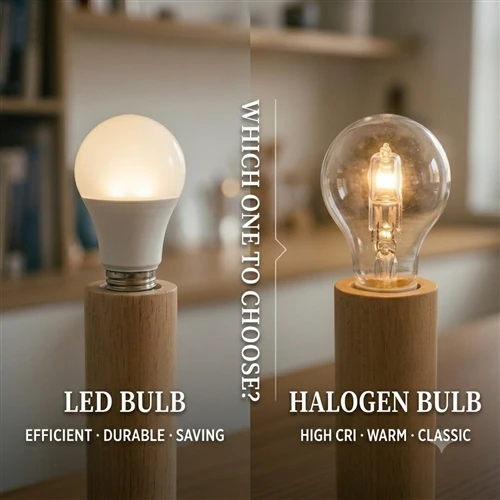
In the home lighting market of 2026, LED bulbs have become the norm, yet many households are still debating whether to say goodbye to the familiar halogen bulbs for good. Faced with rising electricity bills and environmental pressures, it is crucial to understand the differences between LED bulbs and halogen bulbs, as this will help in choosing the best lighting solution.
LED bulbs are far more energy-efficient than halogen bulbs (up to 80% more so), and they also save energy and electricity. They are characterised by a long lifespan and low power consumption, thereby avoiding the cost of replacing bulbs on a regular basis. However, LED bulbs are more expensive than halogen bulbs. So which of these two light sources is the better investment? This article examines the characteristics and differences between LED bulbs and halogen bulbs, as well as their environmental and sustainability aspects, to help you sort through the options step by step, ensuring you can choose with confidence and enjoy a comfortable lighting experience.
What is LED bulb?
LED bulb (Light Emitting Diode Bulb) is an environmentally friendly, energy-efficient and high-performance lighting fixture that converts electrical energy directly into light energy via a semiconductor chip.
Unlike traditional light bulbs, which rely on heating a filament to produce light, LED technology is a form of solid-state lighting.
It is the 'fourth-generation lighting source' following incandescent and fluorescent (energy-saving) lamps, renowned for its high luminous efficacy, long lifespan and low energy consumption, and is currently the mainstream choice for modern lighting. It is primarily used in homes, offices, commercial premises and public facilities.
What is halogen bulb?
A halogen lamp is an upgraded version of the traditional incandescent lamp. It contains a tungsten filament and is filled with a halogen gas (such as iodine or bromine).
When the filament is energised and heats up, the evaporated tungsten atoms undergo a chemical reaction with the halogen gas (known as the halogen-tungsten cycle) and are redeposited onto the filament.
This not only prevents the bulb from blackening but also allows the filament to operate at higher temperatures, thereby giving halogen lamps greater brightness, a longer lifespan and excellent colour rendering compared to ordinary incandescent bulbs.
Key differences between LED and halogen bulbs
To give you a clearer understanding of the differences between the two, the table below compares several key aspects to help you grasp these differences more quickly:
|
Item |
LED bulb | Halogen bulb |
|
Energy consumption |
Very low (5W ≈ traditional 50W halogen) | Very high |
|
Lifespan |
35,000–50,000 hours | 2,000–4,000 hours |
|
Heat output |
Very low (surface feels warm) | Extremely high (surface temperature can reach over 200°C during operation) |
|
Initial cost |
Relatively high (but falling year on year) | Cheap |
|
Long-term running costs |
Very low | Relatively high (electricity bills + frequent replacement) |
|
Luminous efficacy (lumens per watt) |
Extremely high (typically 80–120 lm/W) | Extremely low (typically 15–25 lm/W) |
|
Colour rendering index (CRI) |
High quality (up to 90–98) | Typically 95–100 |
|
Environmental friendliness |
Excellent (mercury-free, low-carbon) | Poor |
|
Safety |
High (low fire risk) | Moderate (high-temperature risk) |
Summary of pros and cons
Please refer to the following sections for the advantages and disadvantages of LED and halogen lamps:
1. LED bulbs
Let's take a quick look at the pros and cons of LED bulbs.

LED bulb light
Advantages of LED bulbs:
1. High luminous efficacy: Scientific research has confirmed that LED lighting technology, based on advanced semiconductor light-emitting principles, offers significant advantages in terms of energy efficiency. Whilst approximately 90% of the electrical energy in traditional incandescent bulbs is lost as heat, LED lighting achieves an overall energy-saving rate of 80% to 90%, thereby substantially reducing energy wastage. Furthermore, high-quality LED drivers can achieve conversion efficiencies exceeding 90 per cent; when combined with high-performance light-emitting chips, this ensures that the vast majority of electrical power is used for effective lighting rather than being wasted. This makes LEDs a truly green, low-carbon light source, aligning with environmental trends whilst meeting the practical demands of modern, high-efficiency lighting.
Supporting link: Wikipedia – Luminous efficacy (comparison table of luminous efficacy and efficiency)
Supporting link: RP Photonics Encyclopedia - Luminous Efficacy and Efficiency
2. Energy-efficient: They are 80% more energy-efficient than any other incandescent bulb. They are even more energy-efficient than CFLs.
3. Low heat output: LED lights generate very little heat but produce plenty of light. They produce 80% light and 20% heat.
4. Safe and environmentally friendly: More suitable for households with elderly people and children.
5. Long service life: Studies show that LEDs have a lifespan ranging from a minimum of 50,000 hours to a maximum of 100,000 hours. They do not need to be replaced frequently.
6. Instant illumination with no delay: They reach full brightness the moment they are switched on; LED lights emit light immediately upon activation without any delay.
7. Supports a variety of colour temperatures and smart control
There is a wide variety of LED bulbs available, ranging from standard bulbs to spotlights and recessed lights, right through to smart dimmable models – there is something for everyone.
Disadvantages of LED bulbs
1. Although LED bulbs have a long service life, their initial purchase price is higher than that of cheaper halogen bulbs.
2. Even LED bulbs can overheat if exposed to high temperatures for prolonged periods. Therefore, in extremely hot environments, you should use wall lights or lampshades to protect them. Prolonged exposure to high temperatures will shorten their service life.
3. LED bulbs emit directional light rather than illuminating in all directions.
2. Halogen bulbs
Let's take a quick look at the pros and cons of halogen bulbs.
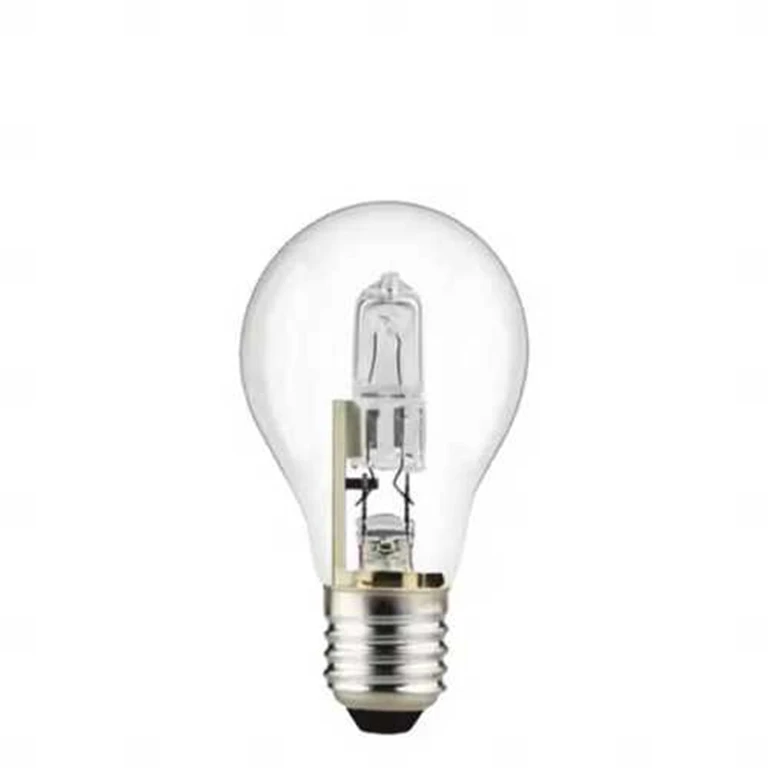
Halogen lamp
Advantages of halogen lamps:
1. Halogen lamps contain tungsten vapour, which prevents the bulb from blackening or dimming; their light intensity does not diminish over time.
2. Halogen lamps are extremely cost-effective: both their manufacturing costs and retail prices are lower than those of LED and xenon lamps.
3. Strong penetration through rain and fog: Their ability to penetrate rain, snow and fog far exceeds that of LED lamps; they reduce diffuse reflection and enhance safety in adverse weather conditions, and are commonly used in automotive lighting.
4. Excellent colour rendering: They have a continuous spectrum and a colour rendering index (Ra) of approximately 100, accurately reproducing the true colours of objects.
Disadvantages of halogen lamps
1. High energy consumption and low efficiency: Halogen lamps convert most of their electrical energy into heat rather than light (only 10–20% is converted into light).
2. High energy consumption: They consume more electricity than LEDs and fluorescent lamps; a 55W halogen lamp provides brightness equivalent to little more than a 10W LED lamp. Long-term use results in high electricity bills, and they do not comply with the energy efficiency standards of many countries.
3. Extremely high temperatures and significant safety hazards: The temperature of the filament and the surface of the quartz glass can reach several hundred degrees, posing a risk of burns, and the glass is prone to breakage.
4. Short lifespan and high failure rate: During prolonged continuous use, the filament is prone to melting in high-temperature environments, resulting in a short lifespan (only 4,000–5,000 hours, which is 1/5 to 1/10 that of an LED lamp). Consequently, halogen lamps require frequent replacement and are troublesome to maintain in the long term.
Limited lighting performance: Halogen lamps have a yellowish colour temperature (2,700–3,000 K), insufficient brightness, a short beam range and poor visibility; they also emit ultraviolet radiation, requiring a filter layer to prevent damage to skin and fabrics.
Except for specific applications, halogen lamps have been completely superseded by LEDs in mainstream areas such as general lighting and car headlights.
Environmental Protection and Sustainability:
As people's expectations regarding quality of life continue to rise, green and low-carbon living has become the mainstream trend, and environmental performance has emerged as a key indicator in the evaluation of lighting products.
Energy Consumption and Carbon Emissions: At the same brightness (lumens), LED lamps consume only 10–15 per cent of the electricity used by halogen lamps, demonstrating significant energy-saving benefits. Lower electricity consumption translates to a substantial reduction in household carbon footprints, whilst also alleviating the load on power stations.
Materials and Recycling: Neither halogen nor LED lamps contain toxic mercury, as found in fluorescent (energy-saving) lamps, making them safer. However, as LED bulbs have a lifespan 10 to 20 times longer than halogen lamps, the number of discarded LED bulbs over their entire lifecycle is far lower than that of halogen lamps, resulting in a substantial reduction in the total volume of electronic waste generated.
Which one is better?
Here are some of the key factors to consider when choosing a light bulb. This section will compare LED and halogen bulbs in various ways.
- Heat Emission:LEDs generate far less heat than halogen bulbs. LEDs convert only 10–20 per cent of the input energy into heat, whereas halogen bulbs dissipate 80–90 per cent of their energy as heat.
- Energy Consumption:The energy-saving benefits of LEDs are significant. An 8-watt LED bulb provides roughly the same brightness as a 90-watt halogen bulb, meaning that LEDs are approximately 10 to 12 times more energy-efficient than halogen bulbs.
- Lifespan:The average lifespan of an LED far exceeds that of a halogen bulb, reaching over 50,000 hours, whereas halogen bulbs typically last only 2,000–4,000 hours.
- Purchase Cost:LED bulbs have a higher unit price, averaging around US$8 to US$10 each; by comparison, halogen bulbs cost only US$3 to US$5.
- Ultraviolet Radiation:LEDs produce absolutely no ultraviolet radiation. Halogen bulbs emit a faint amount of ultraviolet radiation, but this poses no harm to humans; one simply needs to take care not to touch the glass surface whilst the bulb is lit or immediately after it has been switched off.
A Practical Guide to Choosing the Right Lighting: LED or Halogen?
When choosing a light bulb, have you ever found yourself torn over which one is best suited to your needs? There is no such thing as a perfect light bulb; there are only choices that are better suited to specific situations. To save you the time of comparing complex specifications, we've placed LED bulbs and halogen bulbs directly into your everyday home and business scenarios. After reviewing these five typical scenarios, you'll be able to make the most cost-effective and sensible decision straight away.
Scenario 1: Everyday whole-house lighting and commercial office spaces (living room, bedroom, office)
Key requirements: Recommendations for domestic LED bulbs, energy-efficient living room lighting, selection of commercial LED luminaires
Real-life scenarios: Whether it's the living room where the whole family gathers after work, reading by the bedside in the bedroom late at night, or the office space in an office block during the 9-to-5 working day. These spaces share a common characteristic: the lights are on for extremely long periods (approximately 5–10 hours a day), and there is a strict requirement for brightness and stability of the light.
Key buyer concerns:
"Which is more energy-efficient: LED or halogen bulbs? Will next month's electricity bill be sky-high?"
"Frequently changing bulbs is such a hassle-which has a longer lifespan and is more hassle-free?"
"When reading or using a computer under the light for long periods, which type is gentler on the eyes and less likely to cause eye strain?"
The Ultimate 2026 Buying Advice: Without a doubt, go for high-efficiency LED bulbs without a second thought.
Why choose them: LEDs are over 80% more energy-efficient than halogen bulbs and have a lifespan of 35,000+ hours, meaning you'll almost forget what it means to 'change a light bulb'.
Specific product recommendations: For main home lighting or commercial recessed spotlights, we recommend opting for blue-light-filtering, full-spectrum LED spotlights or ceiling lights with a high Colour Rendering Index (CRI ≥ 90) (such as the Philips ComfortLight series or the Panasonic Eye Care series).
Scenario 2: Smart Home Ecosystem and All-Weather Outdoor Lighting
Core Requirements: Smart LED bulbs, motion-sensor outdoor lights, smart home lighting integration
Real-life scenario: You want the hall light to turn on automatically as soon as you walk through the front door, and to be able to dim the lights using your mobile whilst watching a film; or you need a waterproof, flood-resistant sensor light mounted in the garden or by the front gate that will work reliably at night, even when exposed to wind and sun.
Key Buyer Concerns:
"Can this bulb integrate with the Xiaomi Mijia, Apple HomeKit or Matter smart ecosystems?"
"When paired with a motion sensor and frequently switching on and off as people enter and leave, will the bulb burn out easily?"
"Installed outdoors, can it withstand the damp of the rainy season and the bitter cold of winter?"
Ultimate 2026 Buying Advice: This is definitely the domain of LEDs (halogen bulbs cannot achieve smart dimming or withstand frequent on/off cycling).
Why choose it: As a semiconductor chip, LEDs can seamlessly integrate various wireless protocols and are fully capable of withstanding millions of frequent, instantaneous on/off cycles.
Specific product recommendations: For indoor use, we recommend smart dimmable and colour-changing LED mood bulbs that support the Matter or Zigbee protocols (such as Philips Hue, Aqara by Greenmi, and Yeelight); for outdoor use, we recommend LED floodlights equipped with built-in infrared or microwave sensors and a waterproof rating of IP65 or higher.
Scenario 3: Car Headlights in Heavy Fog and Rain (Traditional Upgrades and Replacements)
Key Requirements: Halogen headlight upgrades, headlight penetration in heavy fog and rain, Osram halogen bulbs
Real-life scenario: Driving late at night on a mountain road or an urban flyover when suddenly encountering torrential rain or thick fog with extremely low visibility. At this point, the road surface is shrouded in a white haze, visibility ahead becomes extremely blurred, and the safe following distance drops sharply.
Key Buyer Concerns:
"Which offers better penetration: LED headlights or halogen headlights? Will white light cause glare and impair visibility in foggy conditions?"
"If I replace my halogen bulbs with LEDs without adding a reflector lens, will the beam become scattered, turning me into a 'high-beam hog'?"
Ultimate 2026 Buying Advice: Unless you have specialised lenses fitted, prioritise retaining or replacing your high-intensity halogen bulbs.
Why choose them: Halogen bulbs emit a warm yellow light (2700K–4300K) with a longer physical wavelength, which penetrates airborne particles significantly better than standard cool-white LED light, and carries no risk of light scatter.
Specific product recommendations: We recommend the OSRAM Night Breaker series or Philips Silver Warrior high-intensity halogen headlamps.
Scenario 4: Interior lighting for specialised high-temperature appliances such as microwave ovens and conventional ovens
Key requirements: How to choose an oven bulb, high-temperature-resistant halogen bulbs, replacing microwave oven bulbs
Real-life scenario: Baking enthusiasts baking cakes or roasting meat at home need to be able to observe the expansion and browning of their food at all times through the oven's double-glazed door. In such cases, the temperature inside the oven often reaches as high as 200°C–300°C.
Key buyer concerns:
"Can ordinary LED bulbs be placed in an oven? Will they shatter or melt due to the high temperatures inside?"
"What sort of bulb can withstand the intense heat of several hundred degrees whilst still providing clear, bright lighting?"
2026 Ultimate Buying Advice: You must, and can only, choose specialised high-temperature-resistant halogen bulbs (or traditional incandescent bulbs).
Why choose them: LED chips typically have a maximum temperature tolerance of no more than 100°C and will fail instantly at higher temperatures. Halogen bulbs, on the other hand, utilise heat-resistant tungsten filaments and high-strength quartz glass casings, making them inherently resistant to extreme heat.
Specific product recommendations: When purchasing, search on e-commerce platforms and look for small quartz glass halogen bulbs labelled '300°C heat-resistant' (common bases include G4, E14 or G9).
Scenario 5: Art Galleries, High-End Western Restaurants and Vintage-Style Spaces
Key Requirements: Recommendations for spotlights with high colour rendering, halogen lamps for a vintage ambience, and lighting design for art galleries
Real-life Scenarios: A private gallery is set to exhibit an oil painting with delicate colours; a high-end restaurant wishes to cast an 'appetising' beam of light onto an Angus steak at the dining table; or perhaps you have painstakingly created a vinyl café brimming with an American retro and vintage vibe.
Key Buyer Pain Points:
'Why do ordinary LEDs make the colours of artworks or food appear bluish and cheap?'
"How can I create that 'high-end light pattern' found in luxury hotels-with soft edges, a rich centre and no stray light?"
"My space needs warm, laid-back, dramatic lighting with a touch of narrative-which lights should I buy?"
Ultimate 2026 Buying Advice: We recommend high-quality low-voltage halogen spotlights (or top-tier, museum-grade full-spectrum LEDs).
Why choose them: Halogen lamps possess a natural CRI of 100, offering unrivalled colour rendering of warm tones such as red and yellow. Their unique warm texture and perfectly graduated light pattern are far beyond the reach of the vast majority of standard LEDs.
Specific product recommendations: If budget is not a concern and you are seeking the ultimate in quality, we recommend using low-voltage track-mounted aluminium reflector MR16 halogen spotlights above key works of art or dining tables.
Quick Reference Table: A Single Table to Help You Choose Between LED and Halogen Bulbs
To help you make a quick decision, we've summarised the key scenarios mentioned above in a quick reference table. If you're renovating or planning to replace your lights, simply save this table:
|
Selection Criteria / Target Scenario |
Recommended Light Source | Key Reasons |
|
Living room/bedroom/office (lights on all year round) |
LED bulbs (high colour rendering from leading manufacturers) | Saves over 85% on electricity,long lifespan and maintenance-free |
|
Whole-home smart integration / Outdoor motion sensors |
Smart LED bulbs (Matter/Zigbee) | Supports stepless dimming and colour switching; withstands frequent switching |
|
Car headlights in heavy rain or fog (without lenses) |
High-brightness warm yellow halogen bulbs | Longer wavelengths provide exceptional light penetration in rainy or foggy conditions |
|
Oven/microwave interiors (200°C+) |
Specialised high-temperature-resistant quartz halogen lamps | Quartz casing and tungsten filament, easily withstands temperatures of 300°C |
|
Galleries / upmarket restaurants / vintage-style interiors |
Low-voltage halogen spotlights (or museum-grade LEDs) | CRI=100 for perfect colour rendering, with soft, high-quality light edges |
In-depth analysis: Four key differences you need to know
Beyond differences in application scenarios, there is an insurmountable gap between LED lights and halogen lights in terms of underlying technology and user experience. Before making your final decision, it is worth considering the following four technical dimensions:
1. Spectral range and colour richness
Buyer's consideration: "Does my space require a vibrant, colourful ambience, or a simple warm tone?"
Key differences:
LED lights: Offer virtually limitless colour possibilities. By altering the materials and proportions of the semiconductor chips, they can directly emit a full spectrum of rich colours, including red, yellow, gold, white, blue, green and pink.
Halogen bulbs: Due to the physical limitations of their light-emitting mechanism, they can only produce a single, warm-toned yellow or warm white light.
2. Light-emitting principle and heat output
Buyer's consideration: "Will the surface of the bulb become hot enough to cause burns if left on for a long time? Will the room become warmer?"
Key differences:
LEDs: These are typical 'cold light sources', relying directly on the transition of electrons within a semiconductor to convert electrical energy into light energy. They offer high electro-optical conversion efficiency and maintain a relatively low surface temperature.
Halogen lamps: These are 'thermal radiation light sources', which essentially generate light by passing an electric current through a tungsten filament to produce intense heat. This results in extremely high surface temperatures during operation, significantly increasing the heating load on the room's air conditioning system.
3. Luminous Efficiency (Comparison of Energy Savings and Brightness)
Buyer's consideration: "For the same electricity bill, which one provides more light?"
Key differences:
LED lights: Exhibit remarkable energy efficiency, with typical commercial luminous efficacy ranging from 50 to 100 lumens per watt (lm/W), or even higher.
Halogen lamps: Luminous efficacy is only around 22 to 33 lumens per watt (lm/W), meaning that the majority of the electricity costs are converted into wasted heat.
4. Design and Installation Flexibility
Buyer's consideration: "Will the luminaires fit into various irregularly shaped ceilings, narrow gaps or complex linear designs?"
Key differences:
LED lights: Available in a wide variety of forms, including light strips, light bands, neon lettering and ultra-thin panels, and support a diverse range of installation methods such as recessed, suspended and surface-mounted.
Halogen lamps: Due to the constraints of their glass casings and internal filaments, their size and shape are largely fixed, making highly flexible, customised installation
FAQ: Common Concerns About LEDs and Halogen Bulbs
Q1: If LED bulbs are so energy-efficient, why are they so much more expensive to buy than halogen bulbs?
A: LED bulbs represent a typical upfront investment that pays for itself in the long term. The core component of a halogen bulb is a tungsten filament; the manufacturing process is simple and the production cost is extremely low; whereas an LED bulb contains a complex semiconductor chip, as well as a high-precision electronic driver. Although the initial purchase cost of an LED is approximately double that of a halogen bulb, it can save you over 80% on your electricity bills and has a lifespan 10 to 20 times longer than that of a halogen bulb. Typically, within six months to a year of continuous use, the savings on your electricity bills will be sufficient to recoup the cost of the bulb.
Q2: Is it true that LED bulbs should not be fitted inside completely sealed lampshades?
A: Yes, it is true; LED bulbs are actually very sensitive to heat. Although the light emitted by LEDs is 'cool' (containing no infrared radiation), the semiconductor chip still generates internal heat whilst in operation. If fitted inside a completely sealed lampshade without ventilation holes, or in an extremely hot environment, the build-up of heat will cause the chip to age prematurely, or even lead to the light failing due to overheating. Therefore, in extremely hot or completely sealed fixtures, it is essential to use LEDs with special heat-dissipating casings or to fit a protective cover.
Q3: Are LED bulbs truly environmentally friendly? Do they contain toxins like those found in older energy-saving bulbs?
A: LED lights are very safe and environmentally friendly. Unlike traditional fluorescent lamps (energy-saving bulbs), LEDs contain absolutely no toxic mercury. Furthermore, as LEDs are extremely durable, you will discard far fewer bulbs over their lifespan of tens of thousands of hours compared to traditional lighting, significantly reducing the generation of electronic waste at source. They are a truly green light source that meets the 2026 low-carbon living standards.
Q4: Can I simply unplug my existing old-style halogen spotlights (such as MR16) and replace them with LED bulbs?
A: You cannot simply replace them without checking; you need to confirm the voltage and power supply. Many traditional domestic halogen spotlights (such as recessed ceiling spotlights) operate on 12V low-voltage power and require a transformer for power supply. LED bulbs on the market are available in two types: 220V DC and 12V low-voltage. If you plug them in directly, the transformer in the old halogen spotlight may fail due to a power mismatch, causing the LED bulb to flicker erratically, emit a buzzing sound or even burn out. We recommend consulting a professional electrician or contacting our factory for a customised compatibility solution before making the replacement.
Q5: Will people who frequently use mobile phones or computers be exposed to harmful 'blue light' when using LED bulbs?
A: Early, extremely poor-quality cool-white LEDs on the market did indeed have a problem with 'excessive blue light'. However, as of 2026, technology from major manufacturers has become highly sophisticated. Provided you choose 'Full Spectrum' blue-light-filtering, eye-protective LED bulbs with a Colour Rendering Index (CRI) of 90 or higher, their spectrum will be extremely close to that of natural sunlight. Not only will they pose no risk from harmful blue light, but they will also effectively alleviate the soreness and fatigue caused by prolonged screen use
Conclusion: The Future of Lighting Technology Is Here
Industry trends clearly indicate that LED technology is becoming increasingly affordable and powerful, whilst traditional halogen lamps are gradually being phased out. Whether in large-scale exhibition lighting, bespoke whole-house interior design or commercial space design, LEDs are completely reshaping our relationship with light sources thanks to their unrivalled advantages.
Looking for high-quality custom LED solutions?
We are a specialist manufacturing facility with many years' experience in the lighting industry, specialising in high-end custom LED luminaires. Whether you require lighting for commercial exhibition stands, linear lighting design or bespoke solutions, we can provide you with a one-stop service ranging from high-standard production to direct supply from the source.
Contact us today to receive a bespoke solution and a direct quote from the manufacturer!