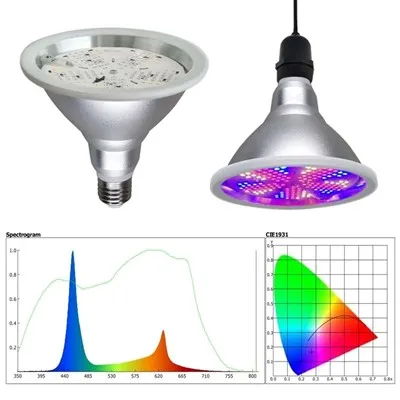

Hey there, fellow plant enthusiasts! I'm a supplier of LED UFO Grow Lights, and today I want to dig into a question that's on a lot of growers' minds: How much power does an LED UFO grow light consume?


First off, let's talk about what makes LED UFO Grow Lights so popular. These lights, like the ones you can check out at UFO Plant Light, have a unique design that mimics the shape of a UFO. They're known for their efficient light distribution and ability to provide the right spectrum of light for plant growth.
Now, when it comes to power consumption, it's not a one - size - fits - all answer. The power consumption of an LED UFO grow light depends on several factors. One of the main factors is the wattage of the light. LED UFO grow lights come in a variety of wattages, typically ranging from 50 watts to 1000 watts or more.
Let's start with the lower - wattage lights. A 50 - watt LED UFO grow light is great for small indoor gardens or for seedlings. These lights consume relatively little power. If you run a 50 - watt light for 12 hours a day, you can calculate the energy consumption using the formula: Energy (in kilowatt - hours) = Power (in kilowatts) x Time (in hours). Since 50 watts is 0.05 kilowatts, running it for 12 hours a day would consume 0.05 x 12 = 0.6 kilowatt - hours per day. Over a month (assuming 30 days), that's 0.6 x 30 = 18 kilowatt - hours.
On the other hand, a high - wattage LED UFO grow light, say a 1000 - watt one, is designed for larger grow spaces. If you run a 1000 - watt (1 kilowatt) light for 12 hours a day, the daily energy consumption is 1 x 12 = 12 kilowatt - hours. In a month, that's 12 x 30 = 360 kilowatt - hours.
Another factor that affects power consumption is the efficiency of the LED chips used in the grow light. High - quality LED chips are more efficient, which means they can produce more light with less power. Our LED UFO Grow Light uses the latest LED technology to ensure maximum efficiency. This not only saves on power consumption but also reduces your electricity bill in the long run.
The spectrum of the light also plays a role. Full - spectrum LED UFO grow lights, like the ones at UFO Grow Light Full Spectrum, are designed to provide all the wavelengths of light that plants need for different stages of growth. These lights might consume a bit more power compared to single - spectrum lights because they have to generate a wider range of light. However, the benefits they offer in terms of plant growth and health make it a worthwhile investment.
It's also important to consider the duty cycle of the grow light. Most growers run their lights for 12 - 18 hours a day, depending on the plant's growth stage. For example, during the vegetative stage, plants usually need more light, so you might run the light for 18 hours a day. During the flowering stage, 12 hours of light might be sufficient. Adjusting the duty cycle can have a significant impact on power consumption.
Let's put things into perspective with some real - world examples. Suppose you have a small indoor herb garden. A 100 - watt LED UFO grow light would be a good choice. Running it for 12 hours a day, it would consume 1.2 kilowatt - hours per day or 36 kilowatt - hours per month. If your electricity rate is $0.15 per kilowatt - hour, your monthly cost for running the light would be 36 x 0.15 = $5.4.
Now, if you have a large commercial grow operation with multiple high - wattage LED UFO grow lights, the power consumption and cost can add up quickly. But remember, the investment in high - quality grow lights can lead to higher yields and better - quality plants, which can offset the cost of electricity.
In addition to power consumption, it's also important to consider the heat output of the LED UFO grow lights. Unlike traditional grow lights, LED lights produce less heat. This means you don't have to spend as much on cooling systems, which can also save you money in the long run.
So, if you're thinking about getting an LED UFO grow light, make sure to consider your specific needs. If you have a small space, a lower - wattage light might be sufficient. But if you have a large grow area, you'll need a higher - wattage light. And always look for lights with high - efficiency LED chips to reduce power consumption.
If you're interested in learning more about our LED UFO Grow Lights or have any questions about power consumption, feel free to reach out. We're here to help you make the best choice for your grow operation. Whether you're a hobbyist or a commercial grower, we have the right grow light for you. Let's start a conversation and see how we can help you achieve the best results for your plants.
References
- General knowledge about LED technology and plant growth lighting.
- Industry reports on energy consumption of grow lights.