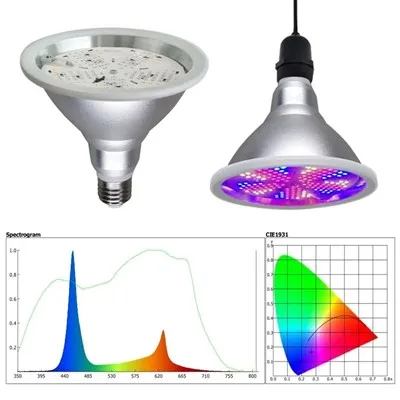

If you've spent any time researching grow lights for indoor gardening or commercial greenhouse operations, you've probably encountered the rise of UV LED grow light bars. These specialized fixtures deliver ultraviolet (UV) wavelengths that can boost plant secondary metabolite production, enhance flavor and aroma in fruits and vegetables, and even strengthen a plant's natural defense against pests. But if you're an operator looking to upgrade your setup, one question that might be lingering: Do these UV LED grow light bars need a special power supply, or can you get by with the same power unit you use for your standard full-spectrum grow lights? As a supplier of UV LED grow light bars and related lighting solutions, I've worked with dozens of growers, from home hobbyists to large commercial farms, and the answer is more nuanced than you might think. Let's break down the science, the technical requirements, and what it means for your setup.
First, it helps to understand how UV LED grow light bars differ from other grow light fixtures, like plant grow light bars or full-spectrum LED grow light bars. Standard grow light bars often combine red, blue, and white LEDs to cover the photosynthetically active radiation (PAR) range, which is critical for plant growth and photosynthesis. UV LEDs, however, operate at much higher forward voltages and have unique current requirements compared to their visible-spectrum counterparts. For example, a typical red or blue LED might have a forward voltage (Vf) of 2.8V to 3.2V, while a UV-A LED (315-400nm) can have a Vf of 3.2V to 4.0V, and a UV-B LED (280-315nm) might reach 4.0V to 5.5V. That difference might sound small, but when you're wiring a string of 20 or 30 LEDs in series, the total voltage demand adds up quickly. A power supply designed for standard red/blue grow light bars might only output 24V or 48V, which would be too low to drive a string of high-voltage UV LEDs. That's a basic but important point: mismatched voltage can lead to insufficient light output, uneven performance across your UV LED grow light bar, or even permanent damage to the LEDs.

Another key factor is current regulation. LED grow light bars, including UV models, are current-driven devices, not voltage-driven. That means they rely on a consistent, controlled amount of current to operate at their rated brightness and lifespan. Standard power supplies designed for visible-spectrum LEDs are often constant-voltage (CV) devices, meaning they output a fixed voltage regardless of draw, and they have no built-in current limiting. If you plug a UV LED grow light bar into a constant-voltage power supply meant for red LEDs, the unregulated current can surge through the UV diodes, causing them to overheat, degrade faster, or fail prematurely. Worse, UV LEDs are particularly sensitive to overcurrent because their semiconductor materials (like gallium nitride) have different heat tolerance than visible-spectrum LEDs. Even a small overcurrent spike can shorten a UV LED's lifespan from 50,000 hours to less than 10,000 hours, which is a costly trade-off for growers who rely on UV's benefits year after year.
That said, not all UV LED grow light bars are the same, and some might work with power supplies that are labeled for general LED use-with a few caveats. For example, if you have a small, low-power UV LED grow light bar (under 50W), it might be designed to pair with a constant-voltage power supply that has a current-limiting resistor. But resistors are inefficient: they waste energy as heat, and they can't adjust if your UV LED's Vf fluctuates slightly due to temperature changes. As a supplier, we've found that even small UV grow lights perform better and last longer with a constant-current (CC) power supply, not just for voltage matching, but for consistent performance. Constant-current power supplies, which are also called LED drivers, regulate the exact amount of current sent to the LEDs, even if their forward voltage changes slightly as they heat up. That stability is critical for UV LEDs, which run hotter than visible-spectrum LEDs because their shorter wavelengths require more energy to produce.
One common mistake we see growers make is trying to repurpose power supplies for waterproof LED grow light bars or plant grow light bars that have lower wattage. Waterproof grow light bars, for example, are designed for high humidity environments, so they often have a lower wattage draw than UV-specific models. Using a power supply meant for a 20W waterproof grow light bar to power a 100W UV LED grow light bar will not only fail to provide enough power but also overload the power supply, leading to overheating and potential fire hazards. On the flip side, using an oversized power supply for a small UV grow light bar is a waste of energy, as it will draw more power than needed and reduce your overall system efficiency.
Another consideration is dimming capability, which is a big feature for commercial growers who want to adjust UV levels based on plant growth stages. Seedlings and young plants need lower UV exposure, while mature flowering plants can benefit from higher doses. Many modern UV LED grow light bars are dimmable, and that requires a power supply that supports dimming protocols, like 0-10V, PWM, or DALI. Standard power supplies for non-dimmable grow lights won't work here, as they can't adjust output to match the dimming signals. If you're running a full-spectrum setup that combines red, blue, and UV LEDs, your power supply needs to sync dimming across all fixtures to ensure even light distribution across your crop.
Let's talk about real-world examples. Last year, a small craft cannabis grower reached out to our team because his UV LED grow light bar was dying after just six months of use. He had bought a generic LED power supply from a local hardware store, paired it with his UV grow lights, and wondered why the LEDs were burning out so fast. When we tested his setup, we found the power supply was a constant-voltage unit with no current limiting, and it was sending 15% more current than the UV LEDs were rated for. We recommended switching to a constant-current power supply rated for UV LEDs, and within a month, his new setup had a 40% longer lifespan and more consistent UV output. That's not an anomaly-we see this all the time with hobbyists who cut corners on power supplies to save a few dollars, only to end up replacing their grow lights and power supplies sooner.
But does that mean you have to buy a power supply specifically labeled "for UV LED grow light bars"? Not necessarily, if you take the time to match the power supply's specs to your fixture. Here's a quick checklist to make sure you get the right fit: First, confirm the total wattage, voltage, and current rating of your UV LED grow light bar (this info should be in the product datasheet). For example, if your UV grow light bar is 60W, 24V, 2.5A, you need a constant-current power supply with a 24V output that can handle at least 2.5A (we usually recommend adding 10-15% headroom to avoid overloading). Second, check if your light is dimmable-if it is, make sure the power supply supports the same dimming protocol as your fixture. Third, if you're running multiple UV LED grow light bars, calculate the total wattage of all fixtures and make sure your power supply can handle that load without exceeding its maximum rated output. You can also check our UV LED Grow Light Bar page for product-specific specs, and our UV Ir Grow Light Bar page for high-intensity, commercial-grade models that have standardized power requirements.
Another point that's often overlooked is thermal management. UV LED grow light bars run hotter than standard grow lights, so your power supply needs to be rated to operate in the same temperature range as your fixtures. If you're using waterproof LED grow light bars in a humid, cool greenhouse, a power supply designed for dry, room-temperature environments might not handle the high humidity or temperature fluctuations, leading to premature failure. That's why many commercial growers opt for power supplies that are IP65-rated or higher, same as their waterproof grow light bars, to ensure durability in harsh environments.
Wait, but what if you're a home grower with a small setup, and you don't want to invest in a specialized power supply? Is there a workaround? For very low-power UV LED grow light bars (under 30W), a constant-voltage power supply with a current-limiting resistor can work in a pinch, but it's not ideal. You'll need to calculate the right resistor value to limit current to your LEDs, and you'll have to monitor the temperature of your light bar closely to make sure the resistor doesn't overheat. For anyone serious about consistent UV performance and long equipment lifespan, though, a constant-current power supply is worth the small extra cost. It might seem like an added expense, but it will save you money in the long run by reducing replacement costs for your grow lights and power supplies.
As a supplier of grow light solutions, we also work with a lot of growers who mix different types of fixtures-for example, using a full-spectrum LED grow light bar for general growth, and a UV LED grow light bar for flowering. In that case, you might be able to use a multi-channel power supply that can power both fixtures, as long as each channel is rated for the correct voltage and current for the UV and full-spectrum lights. That's a great option for commercial growers who want to simplify their wiring and reduce energy waste, as multi-channel power supplies are more efficient than running separate power units for each fixture type. You can learn more about compatible power options on our Plant Grow Light Bar page, where we pair our grow light bars with recommended power supplies to make setup easy.
Let's circle back to the original question: Do UV LED grow light bars need a special power supply? The short answer is: It depends, but for most setups, yes, a power supply designed specifically for UV LEDs (or at least, one that matches your light's voltage, current, and dimming needs) is critical for optimal performance and longevity. Using a standard constant-voltage power supply meant for visible-spectrum LEDs can lead to overcurrent, uneven output, and premature LED failure, while a mismatched wattage power supply can cause overload or underpowering. For hobbyists with small, low-power setups, a basic power supply might work, but it's a gamble that often backfires. For commercial growers, who rely on consistent yields and long equipment lifespan, investing in the right power supply is non-negotiable.
If you're in the market for a UV LED grow light bar or need help choosing a compatible power supply, our team is here to assist. Whether you're looking for a high-power UV grow light for commercial greenhouses, a compact UV Ir Grow Light Bar for home grow tents, or a full-spectrum LED Grow Light Bar that integrates UV wavelengths, we can provide tailored recommendations to fit your setup. Don't hesitate to reach out to our team for procurement inquiries and technical support to ensure your grow light setup is running at peak performance.
References
- National Agricultural Statistics Service. (2022). Commercial Greenhouse and Nursery Production: Grow Light Usage for Specialty Crops. U.S. Department of Agriculture.
- LED Lighting Facts Program. (2021). Performance Requirements for UV LED Grow Lights. Illuminating Engineering Society (IES) of North America.
- Ghaderi, N., et al. (2020). "UV LED Effects on Plant Growth and Secondary Metabolism: A Review." Scientia Horticulturae, vol. 265, p. 109237.
- International Electrotechnical Commission (IEC). (2019). Safety Standards for LED Power Supplies for Horticultural Applications. IEC 61347-2-13.